| Challenging the Coloniality of Ecological Livelihoods: Critical Reflections Ten Years On We re-visit our chapter, "Economy as Ecological Livelihood" ten years later to unpack many of the ways it has reproduced colonialism in its framing and articulation. Seeking to take responsibility for our mistakes, we hope this self-critique can be generative of further work to better align community economies and livelihoods thinking with anti-colonial and decolonial priorities and movements. |
| Responding with and for Joy This piece was written for a Rethinking Marxism (2025) Symposium on The Handbook of Diverse Economies. Dombroski and Gibson-Graham, the co-editors of The Handbook, respond to the four review essays in the Symposium with curiosity amid bizarre and dark times in the global political economy: billionaires co-opting working-class politics in the United States, colonial ambitions in Aotearoa New Zealand undermining Indigenous gains, and environmental devastation deepening despair. The Handbook and review essays together remind us that both old and new thinking tools can offer sustenance. As the reviewers note, wallowing in despair and reifying the bizarre elements of political economy reflects a privileged stance. The fleeting pleasure of being the all-knowing analytical subject—akin to the paranoid subject—offers control over horrors, but at a cost. Inspired by their reviewers, the Handbook co-editors shift from despair and control to the sustained joy of learning from multiplicity and difference, advocating for joy and speculation while inventorying diverse economies to nurture the flourishing Community Economies Institute and the related Community Economies Research Network. Available via Rethinking Marxism, click here. Open access via Massey University, click here. |
| J.K. Gibson-Graham. Hacia una economía postcapitalista o cómo retomar el control de lo cotidiano ¿Es el capitalismo la única realidad existente, una única posibilidad en la que no caben alternativas, tal y como insistentemente se repite? ¿Qué futuro podemos esperar bajo este modelo económico que también busca controlar todo lo que es político, social, y personal? J.K. Gibson-Graham es el pseudónimo conjunto usado por dos geógrafas económicas feministas que, desde principios de los años 1990, vienen mostrando que una visión alternativa al capitalismo es perfectamente posible. Su trabajo se basa en demostrar que el capitalismo no es, ni de lejos, la única vía, que existe una extraordinaria diversidad de praxis económicas y que las personas, a través de nuestras prácticas cotidianas individuales y colectivas, somos agentes de cambio efectivo. J.K. Gibson-Graham nos interpela desde lo que identifica como la política del lenguaje, la política del sujeto y la política de la acción colectiva, transmitiéndonos pautas para generar una nueva mirada a la economía y al territorio, ofreciendo una esperanzadora visión de futuro para nuestras vidas. J.K. Gibson-Graham. Towards a post-capitalist economy or how to regain control of everyday life Is capitalism the only existing reality, the only possibility in which there is no room for alternatives, as is insistently repeated? What future can we expect under this economic model that also seeks to control all that is political, social, and personal? J.K. Gibson-Graham is the joint pseudonym used by two feminist economic geographers who, since the early 1990s, have been showing that an alternative vision to capitalism is perfectly possible. Their work is based on demonstrating that capitalism is far from being the only way, that there is an extraordinary diversity of economic praxis, and that people, through our individual and collective daily practices, are agents of effective change. J.K. Gibson-Graham challenges us from what she identifies as the politics of language, the politics of the subject and the politics of collective action, transmitting guidelines to generate a new look at the economy and the territory, offering a hopeful vision of the future for our lives. Translated with www.DeepL.com/Translator (free version) 
|
| Letter to Julie Letter to Julie was written especially for Antònia Casellas's collection, J.K. Gibson-Graham. Hacia una economía postcapitalista o cómo retomar el control de lo cotidiano [J.K. Gibson-Graham. Towards a post-capitalist economy or how to regain control of everyday life], published by Editorial Icaria, Barcelona. The English translation of the Letter is provided here. In the Letter, written in 2020, Katherine updates Julie on what has happened in the area of diverse and community economies scholarship in the ten years since Julie's death, and on recent events including the climate emergency, COVID-19 and Black Lives Matter. In June 2024, Katherine held a conversation with CERN EU (Community Economies Research Network, Europe) about the Letter to Julie. Click here to access the Zoom recording. |
| The Diverse Economies Approach This chapter, written for the Handbook of Alternative Theories of Political Economy, introduces the two primary theoretical traditions that have shaped diverse and community economies research and practice: anti-essentialist Marxian political economy and feminist poststructuralism. The chapter discusses the contribution of these two traditions highlighted how they have shaped the diverse economies and community economies approach. The chapter also includes a discussion of the ever-evolving practice of making community economies and some research directions for a political economy of possibility. |
| The Handbook of Diverse Economies Economic diversity abounds in a more-than-capitalist world, from worker-recuperated cooperatives and anti-mafia social enterprises to caring labour and the work of Earth Others; from fair trade and social procurement to community land trusts, free universities and Islamic finance. The Handbook of Diverse Economies presents research that inventories economic difference as a prelude to building ethical ways of living on our dangerously degraded planet. Organized into thematic sections, the Handbook moves from looking at diverse forms of enterprise, to labour, transactions, property, and finance as well as decentred subjectivity and diverse economies methodology. The contributing authors from twenty countries are all members of the Community Economies Research Network (CERN) and the cover artwork is by CERN member Ailie Rutherford. ‘Let us forget, just for a moment, “capitalism” and instead investigate the diversity of new forms of economic activities that are flourishing everywhere: this is the essential, energizing, message of J. K. Gibson-Graham, Kelly Dombroski and their colleagues. This innovative book must be absolutely put into all hands. It takes us on a long and rewarding journey around the world to explore ongoing experiences that all attempt to invent new ways of living together.’
– Michel Callon, Centre de Socologie de l'Innnovation, Mines ParisTech, France
The introduction is available free-of-charge, click here. Pre-publication versions of the following chapters (in alphabetical order) are currently available on this website: 
|
| Reading for difference in the archives of Tropical Geography: Imagining an(other) Economic Geography for beyond the Anthropocene This paper is based on the 2016 Neil Smith lecture presented at St Andrews University. It honours the work of a geographer whose pioneering work on uneven development and the complex relations between capitalism and nature shaped late 20th century thinking inside and beyond the discipline of Geography. Today the collision of earth system dynamics with socio-economic dynamics is shaking apart Enlightenment knowledge systems, forcing questions of what it means to be a responsible inhabitant on planet earth and how, indeed, to go onwards ‘in a different mode of humanity’ (to quote eco-feminist philosopher Val Plumwood). ‘The Great Acceleration’ since the 1950s of trends in key aspects of earth system health and socio-economic change highlights powerful dynamics that have shaped a new geological epoch, contentiously named the Anthropocene—or more perhaps to Neil’s liking, the Capitalocene. In this paper I ask how might we do geographic research in these times? I reflect on this question by drawing on the feminist anti-essentialist thinking strategy of reading for difference developed by J.K. Gibson-Graham. I attempt to open up new ways of working with uncertain possibilities. I do so with reference to field research into place-based knowledges of resilience in Monsoon Asia—a region that is experiencing increasingly uncertain and extreme ‘natural’ events that signal Anthropogenic climate change. I return to ‘area studies’ scholarship of Monsoon Asia conducted in the 1950s when the engines of economic change were starting to rev, fuelled by dire predictions of population explosion and the fear of communism. Like Neil, I am interested in the genealogy of geographical scholarship and the institutional contexts in which it developed and was influential. I look back to see how local knowledge was described and appreciated by two of our geographic forefathers and I consider how reading against the grain of capitalocentrism might play a role in making other worlds possible.
This article is freely accessible from the publisher's website. |
| Elävä talous: Yhteisen tulevaisuuden toimintaopas An updated and adapted Finnish language version of Take Back the Economy: An Ethical Guide for Transforming Our Communities by J.K. Gibson-Graham, Jenny Cameron, and Stephen Healy, University of Minnesota Press, 2013.
Click here for the website that can be used in conjunction with the English language version of the book.

|
| Economic Geography, Manufacturing and Ethical Action in the Anthropocene: A Rejoinder We are thrilled by Vicky Lawson’s deeply appreciative response to the Roepke Lecture and the written article. In her response, Vicky does more than we could ask for by inviting economic geographers to think with us about ways of reworking manufacturing (and other economic activities) that center on care for the well-being of people and of the planet. Vicky goes to the heart of our project by highlighting the importance we place on looking for the ethical openings that arise in the current context of climate change and growing socioeconomic inequality. As she identifies, part of our armory includes tactics of attending to already existing possibilities that are hidden from view and reframing understandings of what an economy is for. |
| Roepke Lecture in Economic Geography—Economic Geography, Manufacturing, and Ethical Action in the Anthropocene In a world beset by the problems of climate change and growing socioeconomic inequality, industrial manufacturing has been implicated as a key driver. In this article we take seriously Roepke’s call for geographic research to intervene in obvious problems and ask can manufacturing contribute to different pathways forward? We reflect on how studies have shifted from positioning manufacturing as a matter of fact (with an emphasis on exposing the exploitative operations of capitalist industrial restructuring) to a matter of concern (especially in advanced economies experiencing the apparent loss of manufacturing). Our intervention is to position manufacturing for the Anthropocene as a matter of care. |
| Thinking with Interdependence: From Economy/Ecology to Ecological Livelihoods This chapter, written for the Thinking in the World Reader (Bloomsbury Press), seeks to challenge and think beyond a key blockage in contemporary life: the conventional distinction between economy and ecology. As we argue, the distinction between these two domains severs us from transformative, ethically-infused encounters with our constitutive interdependencies. We explore one possible way to affirm and expand the politicization of this interdependence: a notion of "ecological livelihoods" linked with an ethics and politics of commoning. |
| Re-embedding Economies in Ecologies: Resilience Building in More than Human Communities The modern hyper-separation of economy from ecology has severed many of the ties that people have with environments and species that sustain life. In this paper we argue that a first step towards strengthening resilience at a human scale involves appreciating the longstanding social and ecological relationships that have supported life over the millennia. Our capacity to appreciate these relationships has, however, been diminished by economic science which encloses ecological space within more and more delimited confines. Our task is thus to cultivate new sensibilities that will enable us to enact resilience in both our thinking and practice. The theoretical argument of this paper will be illustrated drawing on examples from a research project on strengthening economic resilience in Monsoon Asia. We explore how people and environments have co-produced ways of living with severe climatic disturbance. While longstanding infrastructural assemblages have been devalued or destroyed by modernization, key elements of these assemblages are now the subject of much interest. Bamboo, a building material central to survival in Monsoon Asia, has been dismissed as a viable element of modern Asia’s built environment. But this is changing as the properties of bamboo are re-evaluated. When humans are resituated within the vegetative assemblages that have supported life in Asia over the long durée we can begin to explore the ethical practices of bamboo and the ecological actions of humans that might co-produce more resilient and liveable futures. |
| Cultivating Community Economies This paper was commissioned by the Next System Project (co-chaired by Gar Alperovitz and by Gus Speth). The paper details community economies thinking, and covers the following topics:
- key commitments of community economies thinking
- understandings of transformation
- community + economy
- strategies for cultivating community economies (namely, applying the language of diverse economies and broadening the horizon of economic politics)
The paper includes examples of community economies from across the globe (including those that are 'local' an place-based (such as Hepburn Wind) to those that are 'global' (such as the Montreal Protocol on Substances that Deplete the Ozone Layer).
The paper concludes with a summary of over 20 examples of community economies research projects that are being undertaken across the globe by members of the Community Economies Collective. 
|
| ‘After’ area studies? Place-based knowledge for our time From today’s perspective, early 20th century ‘Area Studies’ texts represent a relic form of geographical research and writing. These compendiums of place-based knowledge present what we now consider to be a layperson’s understanding of ‘geography’ – details of landforms, climate, land use, economic activities, urban patterns and so on. This empirical content is described in language littered with the judgemental adjectives associated with hierarchical knowledge systems such as environmental determinism, economic stage theory and theories of modern state formation. In this essay I interrogate one subset of these texts, namely those that were written about Tropical or Monsoon Asia, as it was often referred to. I situate the publication of these geographies with respect to major shifts in human and earth systems and outline some preliminary ideas for how we could re-read these texts to recover place-based knowledge that might inform current research on economic resilience in Southeast Asia. |
| Commoning As Postcapitalist Politics Today the planet faces a genuine tragedy of the unmanaged “commons.” For decades an open access and unmanaged resource has been treated with the same sort of disregard as Hardin’s pasture was treated. The planet’s life-supporting atmosphere has been spoiled by “‘help yourself’ or ‘feel free’ attitudes” (Hardin 1998: 683). We are now faced with the seemingly impossible task of transforming an open access and unmanaged planetary resource into a commons which is managed and cared for. With the cause and impacts of global warming now beyond debate, we are being pressed to take responsibility and to act in new ways. But how are we to do this? What type of politics is called for? |
| Pursuing Happiness: The Politics of Surviving Well Together In this paper we use the concept of surviving well to reframe contemporary discussion of happiness and wellbeing in the context of international development discourse. While the attempts to move beyond metrics that privilege economic growth as the singular indicator of progress, it's equally true that our understanding of happiness and wellbeing needs to move beyond individual notions of contentment and towards a measure that allows people to thinking about their own needs in relation to others and in relation to planetary wellbeing. |
| Building Community Economies: Women and the Politics of Place Women and the Politics of Place (WPP) is a project of narrating and theorizing a globally emergent form of localized politics — one that is largely of if not necessarily for women — with the goal of bringing this politics into a new stage of being. What is truly distinctive about WPP is the vision of a place-based yet at the same time global movement (Osterweil 2004). Indeed this distinctive vision is what first attracted us to the project, for we were already imagining and fostering an economic politics with the same locally rooted yet globally extensive structure. Rather than ‘waiting for the revolution’ to transform a global economy and governance system at the world scale, we were engaging with others to transform local economies here and now, in an everyday ethical and political practice of constructing ‘community economies’ in the face of globalization. |
| Economy as Ecological Livelihood This book chapter challenges the conventional separations between "economy" and "ecology," proposing instead a perspective of "ecological livelihoods" in which sustenance is understood as an always-collective process of ethical negotiation involving humans and myriad living others. Drawing on and modifying Gibson-Graham's previous work on "ethical coordinates," we suggest some glimmers of what an ethical economics in an acknowledged more-than-human world might look like. [UPDATE: We also include here a 2025 addendum, "Challenging the Coloniality of Ecological Livelihoods: Critical Reflections Ten Years On." Please read this along with the original text]. |
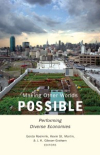
| Making Other Worlds Possible: Performing Diverse Economies What exactly constitutes an economy? Making Other Worlds Possible brings together a compelling range of projects inspired by the diverse economies research agenda pioneered by J. K. Gibson-Graham. Firmly establishing diverse economies as a field of research, Making Other Worlds Possible outlines an array of different ways scholars are enacting economies that privilege ethical negotiation and a politics of possibility.
What makes the book so special is that each of authors know the communities they speak of and they write with real passion — Antipode
|
| Rethinking the Economy with Thick Description and Weak Theory This paper was written as part of a suite of papers presented at a Wenner-Gren Foundation Workshop on ‘Crisis, Value and Hope: Rethinking the Economy.’ It brings diverse economy thinking and the practice of weak theorizing to bear on the anthropological interest in producing thick description. |
| Being the Revolution, or, How to Live in a 'More-Than-Capitalist' World Threatened with Extinction Much of J.K. Gibson-Graham’s work has been aimed at opening up ideas about what action is, both by broadening what is considered action (under the influence of feminist political imaginaries and strategies), and by refusing the old separation between theory and action. But the coming of the Anthropocene forced Julie and I to think more openly about what is the collective that acts. In this lecture I ask: what might it mean for a politics aimed at bringing other words into being to displace humans from the centre of action and to see more-than-human elements as part of the collective that acts? The lecture proceeds with sections discussing 1) elements and limits of a feminist imaginary of possibility, 2) the synergies between a politics of building community economies and the political imaginary of actor network theory, and 3) the materiality of emerging community economy assemblages. |
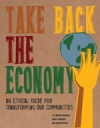
| Take Back the Economy: An Ethical Guide to Transforming Our Communities Take Back the Economy dismantles the idea that the economy is separate from us and best comprehended by experts. It demonstrates how the economy is the outcome of the decisions and efforts we make every day. Full of exercises and inspiring examples from around the world, it shows how people can implement small-scale changes in their own lives to create ethical economies. Click here for a copy of the introduction (provided with the publisher's permission).
Click here for the website that can be used in conjunction with the book.
A must read for those who seek to change the world bottom up — Massimo De Angelis
The single most farsighted and practical work enlightening us on the path to a steady transition towards a genuine postcapitalist world — Arturo Escobar
|
| Economic Imaginaries This chapter, drawn from previous writings by J.K. Gibson-Graham, is part of a collaboration with artist Sarah Browne for the Ireland exhibition in the 2009 Venice Biennale. The piece provides an overview of some of the core thinking that emerged in the 10 years between the publication of The End of Capitalism (1996) and A Postcapitalist Politics (2006). |
| Thinking with Marx For a Feminist Postcapitalist Politics The article discusses the theoretical openings accorded by the recognition of economic difference and contingency within the Marxist tradition, exploring their potential contributions towards imagining and enacting a postcapitalist politics of economic transformation and experimentation. |
| The Nitty Gritty of Creating Alternative Economies Amidst widespread concern about the economy, this paper explores how academic researchers can contribute to the work underway to create environmentally orientated and socially just economies. We offer the diverse economies framework as a technique with which to cultivate ethical economies. |
| A Feminist Project of Belonging for the Anthropocene At the core of J.K. Gibson-Graham's feminist political imaginary is the vision of a decentralized movement that connects globally dispersed subjects and places through webs of signification. We view these subjects and places both as sites of becoming and as opportunities for belonging. But no longer can we see subjects as simply human and places as human-centered. Th arrival of the Anthropocene has thrown us onto new terrain. |
| Forging Post Development Partnerships: Possibilities for Local and Regional Development A post-development approach to world-making has arisen from a critique of the idea that development, especially economic development, is yoked to capitalist growth. This approach extends the long tradition of critique that has accompanied the hegemonic rise of a mainstream development project focused on the 'problem" of less developed regions of the world. As we see it, the challenge of post-development is not to give up on development, but to imagine and practice development differently. Thus post-development thinking does not attempt to represent the world as it is, but the world as it could be. |
| An Economic Ethics for the Anthropocene Faced with the daunting prospect of global warming and the apparent stalemate in the formal political sphere, this paper explores how human beings are transformed by, and transformative of, the world in which we find ourselves. |
| Community Enterprises: Imagining and Enacting Alternatives to Capitalism If the rise of the World Social Forum is any indication, there is a groundswell of support for alternatives to capitalism. But within this movement that links North and South, ‘developed’ and less ‘developed’ nations worldwide, the debate as to what constitutes an economic alternative is fraught with judgments about the purity or contamination of what is on offer. Wholehearted experimentation with the premise that ‘other economies are possible’ is held back by the critical voices (many in our own heads) arguing that this or that element of an alternative project is no different from capitalism or is insufficient to withstand the colonizing forces of the ‘capitalist’ market. J.K. Gibson-Graham’s recently published book A Postcapitalist Politics (2006) argues that the danger of taking too much notice of these objections is that desires for alternatives become destabilized and the intentional practice of building alternatives gets undermined. It seems that a prerequisite for enacting economic alternatives to capitalism is an affective stance that will enable us, as authors, researchers and activists, to be a condition of possibility (rather than impossibility) for the emergence of other worlds and other economies. In this short chapter we discuss how we have cultivated a stance that enables possibility, while building economic alternatives alongside or perhaps outside of something called ‘capitalism’. |
| A Postcapitalist Politics of Dwelling In this article we draw on community economies and ecological humanities scholarship to tackle perhaps the most pressing question of our time. How do we live together with human and non-human others? |
| Social Innovation for Community Economies In this chapter we stage a conversation between two innovative and longstanding projects, (1) the multiphase European-based research project on local social innovation that is represented in this book and (2) the Community Economies project which is engaged in rethinking economy through action research in Australia, the Philippines and the US. |
| Remarx. “Place-Based Globalism”: A New Imaginary of Revolution Over the past several decades a revolutionary “politics of place” has emerged around the world, linked through globally accessible media, loosely coordinated federations, and international gatherings, most notably the World Social Forum. While traditional revolutionary politics confronts a single space of dominion, the politics of place imagines and creates multiple spaces of freedom and self-determination. It is a politics of the here and now, embedded in place yet globally transformative. |
| Diverse Economies: Performative Practices for 'Other Worlds' In this paper we describe the work of a nascent research community of economic geographers who are making the choice to bring marginalized, hidden and alternative economic activities to light in order to make them more real and more credible as objects of policy and activism. The diverse economies research program is, we argue, a performative ontological project that builds upon and draws forth a different kind of academic practice and subjectivity. |
| Socially Creative Thinking, or How Experimental Thinking Creates ‘Other Worlds' The KATARSIS research project responds to one of the most pressing questions of our times; how to live together? In EU countries this concern has focused on creating conditions for social cohesion, especially by researching the ways that processes of exclusion and inclusion operate. On the global stage the question of how to live together has gained increasing weight in recent times in the light of climate change, public health challenges and economic crisis. Hard-hitting questions about basic needs, consumption levels, capitalist surplus, and the environmental commons that have been suppressed in the language of cohesion and inclusion are beginning to surface. |
| Surplus possibilities: Post-development and community economies In recent years, development practitioners, anthropologists, geographers and others who are observers ‘on the ground’ of the failures of the one-size-fits-all model of development have begun to generate a ‘post-development’ discourse (Rahnema with Bawtree, 1997). By this, we mean a set of thinking and doing practices that are guided by a distinctive ethical stance. Post-development discourse is aligned with the long leftist tradition of critical analyses that accompanied the global consolidation, immediately after the Second World War, of a hegemonic mainstream development project. But while sharing a dissatisfaction with mainstream development, this emerging post-development discourse effects a radical rupture with a style of thinking that underpins much of the critique of development. In this chapter, we aim to give a taste of how we are broaching the practice of post-development thinking in a linked set of projects — a language project of representing the economy as diverse, a collaboration with an NGO that is involved in what we see as post-development interventions in the global trade in labour and an action research project negotiating post-development pathways in place in a Philippines municipality. |
| Imagining and Enacting a Postcapitalist Feminist Economic Politics We, like Hester Eisenstein, have been encouraged by the resurgence of interest in "discussions about capitalism, socialism, and alternative economic systems" and by the innovative organizing energies of "those who believe that another world-a postcapitalist world-is possible." Indeed, our forthcoming book A Postcapitalist Politics (Gibson-Graham 2006b) takes up the very question of an alternative economic politics and, as the sequel to The End of Capitalism (as We Knew It): A Feminist Critique of Political Economy (1996, 2006a), does so with feminist politics as its guiding inspiration. So it is fascinating to both agree with Eisenstein's core plea, that the women's movement "align itself with the struggle for alternatives to the current economic world order," and yet diverge in so many ways from her challenging stock-taking of feminism's achievements and failures. We wonder whether our idiosyncratic offerings in answer to the question "What is to be done?"(we might ask, "What is being done?") could in any way satisfy Eisenstein, built as they are upon an affiliation with poststructuralist feminism, queer theory, and antiessentialist Marxism. In this brief response to her engagingly personal and provocative essay, we identify some of the theoretical insights we have drawn from these lines of thought and the key elements of feminism's political contribution that we build on to forward our postcapitalist (feminist) political imaginary. As the narrative of her life experience illustrates, Hester Eisenstein has benefited from the gains feminism has been able to effect and she is somewhat amazed at the" ease with which gender discrimination could be reversed," virtually in one lifetime. This leads her to observe that" gender has been a much more malleable feature of public life than either race or class." Her assessment seems to oddly devalue the achievements of feminism, suggesting that gender was an easier target than these other dimensions of social life. |
| A Postcapitalist Politics In this creatively argued follow-up to their book The End of Capitalism (As We Knew It), J. K. Gibson-Graham offer already existing alternatives to a global capitalist order and outline strategies for building alternative economies. A Postcapitalist Politics reveals a prolific landscape of economic diversity—one that is not exclusively or predominantly capitalist—and examines the challenges and successes of alternative economic interventions.
![[cover image]](/sites/default/files/styles/thumbnail/public/2017-11/image_mini.jpeg?itok=PxoKAuSD)
|
| The Violence of Development: Two political imaginaries J.K. Gibson-Graham explores two responses to the violence of development – the politics of empire and the politics of place. Drawing on the well-known book Empire by Hardt and Negri, the experience of the SID project on Women and the Politics of Place, and a slum dwellers' initiative in India, she attempts to open up alternatives to the dominance of capital and affirm a new political space. |
| Area Studies after Poststructuralism In this paper we address the question of ‘what next after poststructuralism’ through a reassessment of area studies. In a narrative of our own involvement with place-oriented research and institutions, we examine the traditional position of area studies in geography and anthropology and its reevaluation by poststructuralist scholars in a number of disciplines. We argue that both prestructuralist and poststructuralist treatments of areas are oriented by a narrative of capitalist development; at the same time, we recognize that traditional area studies has a deep interest in noncapitalist economic practices and relations. It is therefore a resource for those of us who want to create a discourse of economic diversity as a contribution to a politics of economic innovation. The latter half of the paper presents an extended example of reading for economic difference drawn from fieldwork in the oil-palm sector in Papua New Guinea. We conclude with a ‘post-poststructuralist’ reflection on geographic field research. From our evolving perspective, the fieldwork practices that are the principal research methods of area studies constitute a relatively untheorized form of academic politics, creating differences in thought (and thus in the world) via new interpenetrations of concepts and ‘matter’. |
| Enabling Ethical Economies: Cooperativism and Class Situates contemporary evaluations of the success of Spain's Mondragon cooperative complex within a tradition of debate about the politics of economic transformation and argues for the development of an economics of surplus that can guide ethical decisions in community economies. |
| Feminising the Economy Exploring how recent feminist thinkers are attempting to add women into the economy. |
| An Ethics of the Local Principles and practices for cultivating a local ethics of economic transformation. |
| Beyond Global vs Local: Economic Politics Outside the Binary Frame Offers a counter to the common denigration of local economic politics 'in the face of globalization'. |
| Re/Presenting Class: Essays in Postmodern Marxism Re/presenting Class is a collection of essays that develops a poststructuralist Marxian conception of class in order to theorize the complex contemporary economic terrain. Both building upon and reconsidering a tradition that Stephen Resnick and Richard Wolff—two of this volume’s editors—began in the late 1980s with their groundbreaking work Knowledge and Class, contributors aim to correct previous research that has largely failed to place class as a central theme in economic analysis. Suggesting the possibility of a new politics of the economy, the collection as a whole focuses on the diversity and contingency of economic relations and processes. ![[cover image]](/sites/default/files/styles/thumbnail/public/2017-11/41-wJzQOJqL._SX348_BO1%2C204%2C203%2C200_.jpg?itok=CZ75qO3x)
|
| Class and Its Others The authors offer new and compelling ways to look at class through examinations of such topics as sex work, the experiences of African American women as domestic laborers, and blue- and white-collar workers. Their work acknowledges that individuals may participate in various class relations at one moment or over time and that class identities are multiple and changing. Taken together, the essays in this book will prompt a rethinking of class and class subjectivity that will expand social theory.
Contributors: Enid Arvidson, Jenny Cameron, Harriet Fraad, Janet Hotch, Susan Jahoda, Amitava Kumar, Cecilia Marie Rio, Jacquelyn Southern, Marjolein van der Veen. ![[cover image]](/sites/default/files/styles/thumbnail/public/2017-11/image_large.jpeg?itok=xdIrEznv)
|
| Poststructural Interventions This chapter in the Companion to Economic Geography overviews three poststructural strategies: deconstruction; discourse analysis and genealogy; and performativity. It then uses examples to show how these strategies have been picked up in the work of economic geographers, and it concludes by focusing how economic geographers have used these strategies in research projects that have an explicit agenda to help shape positive change in the world. Overall, the chapter aims to give a sense of the powers and potentials of poststructural interventions. |
| ‘“Stuffed if I Know!”: Reflections on Post-modern Feminist Social Research' Empirical studies conducted from a range of theoretical perspectives have all in some way affirmed the existence of women's experience as a source of privileged understandings, if not the basis of an alternative social science. With the turn to post-modernism many of the certainties of a feminist research practice have been dislodged. This has liberated a plethora of exciting philosophical, political and cultural endeavours that tackle the essentialism around women embedded in both feminist and non-feminist texts. The focus in the socialist-feminist literature upon industrial disputes, in which women are expected to express their real identities through solidarity with working-class men, situates this literature solidly within essential Marxism-feminism where consciousness is true or false and subjectivity structurally constructed and constrained. In dissolving the presumed unity of women's identity post-modern feminism has liberated knowledge and given rise to fruitful theoretical controversies as to who women are' and how to know' them. |
| Queer(y)ing Capitalist Organization "Recently I attended a conference on globalization and global regulation which was organized by some left social scientists at a university in the USA. One thing I noticed in many of the contributions was the way in which everything was centered on or by capitalism, almost by default. Regulation was seen as focused upon capitalism and ultimately became part of a capitalist formation. Non-capitalist social sites (including the household and the state) were involved in the reproduction of capitalism, perhaps in new forms. Even opposition was situated within capitalism, defined and ultimately coopted by it. Over the course of the conference, what was incrementally produced was an image of a unified and univocal social space, the sort of thing that's called a “capitalist” society—or in this case a global capitalist economy or just global capitalism..." |
| The End of Capitalism (As We Knew It): A Feminist Critique of Political Economy In the mid-1990s, at the height of discussion about the inevitability of capitalist globalization, J. K. Gibson-Graham presented a groundbreaking argument for envisioning alternative economies. This new edition includes an introduction in which the authors address critical responses to The End of Capitalism and outline the economic research and activism they have been engaged in since the book was first published. The witty and incisive spliced author, J.K. Gibson-Graham, has given us a superb tool for undoing the strangling grip of the ways we understand capitalism. The End of Capitalism made me feel like an iron strap was removed from my lungs. In a wave of relief, I experienced Gibson-Graham to be teaching me to breath again outside the depleted atmosphere in which the story of Capitalism always and everywhere fills all space and time Donna Haraway, 1996
The Full Endorsement by Donna Haraway, 1996 The witty and incisive spliced author, J.K. Gibson-Graham, has given us a superb tool for undoing the strangling grip of the ways we understand capitalism. The End of Capitalism made me feel like an iron strap was removed from my lungs. In a wave of relief, I experienced Gibson-Graham to be teaching me to breath again outside the depleted atmosphere in which the story of Capitalism always and everywhere fills all space and time. By helping me notice again how much of the present world is not accounted for by the mega-narrative of the Monster Capital, Gibson-Graham teaches me to work more effectively toward a well-nourished and well-aerated non-capitalist economy, culture and society. Gibson-Graham knows how to see the glimmerings and hear the mutterings of non-capitalist practices amidst the cacophony of accounts of the ubiquitous and all-powerful Presence of Capital. The book helps feed the starving waif of a world-changing left political imagination. The End of Capitalism teaches its readers to hear and see what already exists in irreducible specificity—and to understand why it is so hard to narrate and explain these realities. The point of this controversial and risk-taking book is to learn with intellectual rigor and lusty strength how to enlarge non-capitalist worlds on the real earth. 
|
| Querying Globalization |
| Identity and Economic Plurality: Rethinking Capitalism and ‘Capitalist Hegemony’ In the work of Chantal Mouffe, society is seen as structured by a hegemonic articulation, but one that is only temporarily fixed and always under subversion. Following Mouffe, in this paper I pursue the implications of theorizing ‘the economy’ as a hegemonic formation rather than as a fixed capitalist totality. What might it mean to understand ‘the economic’ as a provisional articulation of capitalist and noncapitalist activities and relations? How might it open up the possibility of anticapitalist and noncapitalist economic interventions? Encouraged by feminist attempts to produce a discourse of sexual difference that is not subsumed to a binary gender hierarchy, I envision a discourse of economic difference that could destabilize and problematize the presumption of capitalist hegemony. |
| Waiting for the Revolution, or How to Smash Capitalism while Working at Home in Your Spare Time This paper has a surplus of titles. The authoritative title is “Rethinking Capitalism,” affirming a connection with Rethinking MARXISM and with the larger movement to “rethink” received concepts; indeed, to question the entire epistemic foundation that has rendered such concepts prevalent and effective. The querulous title is “Why can feminists have revolution now, while marxists have to wait”? I’m drawn to this question about feminism and revolution, even though it may be a little misleading.’The question points to the proximity of social transformation for certain feminisms-that image of gender as something always being renegotiated, that vision of social transformation taking place at the interpersonal level as well as at the level of society as a whole. Those things make the marxist in me envious of the feminists within and outside me. My feminism reshapes the terrain of my social existence on a daily basis. Why can’t my marxism have as its object something that I am involved in reconstructing every day? Where is my lived project of socialist construction? |