
Artful Evaluation for Creative Health and Wellbeing

Molly Mullen
Rand Hazou
Sarah Woodland
Artful Evaluation cover

This open access book presents new methods for evaluating the contribution of participatory arts to health and wellbeing. Responding to shifts in arts and health discourse, it argues for challenging long-standing ideas about how value is theorised, measured, and communicated. This book critiques the dominance of social impact as the primary way of understanding change in arts, health, and wellbeing, proposing instead evaluation approaches grounded in contemporary Indigenous, post-humanist, and postcapitalist theories.
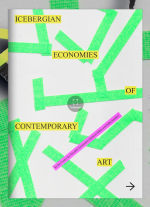
Icebergian Economies of Contemporary Art

Kathrin Böhm
Kuba Szreder

“Icebergian Economies of Contemporary Art” by Kathrin Böhm and Kuba Szreder (Centre for Plausible Economies) offers reflections on art and economy, stimulated by J. K. Gibson-Graham’s representation of the economy as an iceberg. Just as the capitalist economy is the peak of the iceberg, the glossy world of celebrity art dominates over the vast—yet invisible—realm of artistic dark matter, the realm of artistic labour that sustains the social gravity of the artistic universe, just as physical dark matter prevents the cosmos from collapsing.

How to reclaim the economy using artistic means: the case of Company Drinks

Kathrin Böhm
Kuba Szreder

The chapter proposes a critical and practical approach towards acknowledging that most artists not only support their practices through a diverse range of incomes and support systems, but that an increasing number of artists conceptualize and enact artistic practices which resist the extreme commodification of mainstream arts, and are creating new plausible art worlds based on the concept of usership versus the conventional and dominant model of spectatorship.

Icebergian Economies of Contemporary Art

Kathrin Böhm and Kuba Szreder
Icebergian Economies of Contemporary Art  (together with Kuba Szreder)

Icebergian Economies of Contemporary Art offers reflections on art and economy, stimulated by J.K. Gibson-Graham’s representation of the economy as an iceberg. Themes include visible/invisible; blue line or the surface; the gloss over the dark matter; me versus the many; and art world/s.