
Publications
Highlights
•Community gardens are often seen as temporary uses of vacant land.
•Gardeners see them as important parts of neighborhoods and cities.
•Local governments and organizations historically planned gardens to be temporary.
•Increasingly, gardeners reproduce those dominant narratives as well.
•Rethinking these transformations can lead to better policy toward vacant land.
Abstract
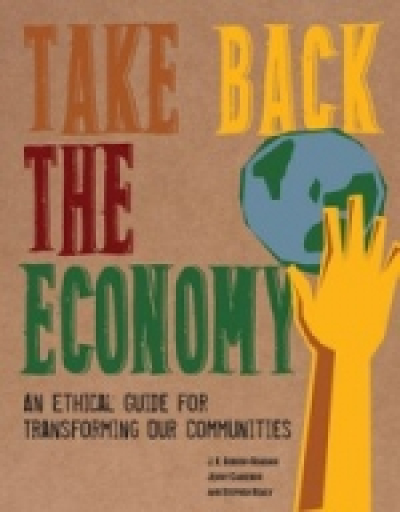
Take Back the Economy dismantles the idea that the economy is separate from us and best comprehended by experts. It demonstrates how the economy is the outcome of the decisions and efforts we make every day. Full of exercises and inspiring examples from around the world, it shows how people can implement small-scale changes in their own lives to create ethical economies. Click here for a copy of the introduction (provided with the publisher's permission).
Click here for the website that can be used in conjunction with the book.
Artists and artisans have a crucial role in the sustainability of the creative economy. By utilizing a participatory action research approach seeded by the work of J. K. Gibson-Graham, Jenny Cameron, and Julie Graham's study of community economies in the Pioneer Valley, The Rethinking the Creative Economy Project demonstrates how a collaborative research methodology can reappropriate development from the exploitation of artists and artisans as a panacea for economically challenged communities and as a tool that can help perform a postcapitalist environment.
This introduction shows how J. K. Gibson-Graham's work continues to inspire current scholarship in the Marxian tradition. It provides an overview of articles published in Rethinking Marxism as Part I of a two-part symposium.
In this paper I explore how notions of dwelling might be adapted to explain how diverse economic practices produce new economic spaces and subjectivities within and beyond the home.
This paper explores and elaborates on J.K. Gibson-Graham's concept of "community economy," refracting it into three interrelated dimensions of ontology, ethics and politics, and placing them in conversation with one another via comparative explorations of both community economy and solidarity economy as contemporary articulations for radically-democratic economic organizing.
This short essay considers the limitations of critical anthropological theory and in particular critiques of capitalism. We suggest that anthropology's emancipatory potential can be found in an approach that embraces anthropology's moral optimism and merges critique with a politics of possibility.
This essay explores the discursive production of numerous, well-meaning efforts to respond to social and economic restructuring in Kalamazoo, Michigan. Drawing upon the work of Slavoj Zizek, we suggest that the focus on what is perceived to be reasonable, or realistic, is maintained by and helps to maintain, the normal workings of capitalist exploitation which appear as inevitable, natural, or altogether invisible.
Article for the Planning Institute of Australia (NSW) journal
The article discusses the theoretical openings accorded by the recognition of economic difference and contingency within the Marxist tradition, exploring their potential contributions towards imagining and enacting a postcapitalist politics of economic transformation and experimentation.
A review of the film Warm Bodies (2013), a dark-comedy featuring zombies and romance. We read Warm Bodies as inhabiting today's growing social imaginary and belief that even amidst growing inequalities, austerity and unfolding ecological challenges, another world is truly possible.
In this short commentary, I engage with other economic geographers reflecting on whether there is an 'Antipodean' Economic Geography. I argue that this is less a matter of fact and more of a point of gathering: by naming and gathering something called an Antipodean Economic Geography, what possibilities do we enable and disable for new kinds of economies and geographies?
This paper explores what we might call "diverse economies of surplus," attempting to further develop Gibson-Graham's notion of surplus as an "ethical coordinate" and examining a number of key ethical and political questions raised when surplus is pushed beyond its conventional Marxian formulation.
This article engages with the notion of the city as capitalist space, focusing on the specific actors that come together to realign economically heterogeneous spaces into the monolithic, capitalist city.
Much of J.K. Gibson-Graham’s work has been aimed at opening up ideas about what action is, both by broadening what is considered action (under the influence of feminist political imaginaries and strategies), and by refusing the old separation between theory and action. But the coming of the Anthropocene forced Julie and I to think more openly about what is the collective that acts. In this lecture I ask: what might it mean for a politics aimed at bringing other words into being to displace humans from the centre of action and to see more-than-human elements as part of the collective that acts?
Paper on doctoral research in process.
Written as a response to a series of commentaries on 'Antipodean Economic Geography’ this piece draws on my fieldwork experience to question whether it is useful to invoke the ‘otherness’ of the Antipodes. I call for a habituation of the practice of looking for difference as a way of cutting across the Antipodean-Metropole binary invoked in the discussion.
Competitively selected paper presented at the inaugural Social Frontiers: The Next Edge of Social Innovation Research conference in London, November 2013.
Phil Ireland and I collaborated on this paper during his PhD studies while I was at Macquarie University. We sought to bring together his work on Climate Change Adaptation with my thinking on post-development. We argue that when it comes to efforts to support Climate Change Adaptation in the majority world, it is important to challenge technocratic approaches that dismiss the value of local innovations. Instead we draw inspiration from the work of J.K. Gibson-Graham and their injunction to refuse to know too much.
This chapter, drawn from previous writings by J.K. Gibson-Graham, is part of a collaboration with artist Sarah Browne for the Ireland exhibition in the 2009 Venice Biennale. The piece provides an overview of some of the core thinking that emerged in the 10 years between the publication of The End of Capitalism (1996) and A Postcapitalist Politics (2006).
In this paper we explore how international development discourse has placed women at the center of a "smart economics" approach to economic development. While we are heartened by development discourse's new found interest in economies of care and social reproduction, we are troubled by the way that an essentialized conception of gender is attached to a economic growth as usual agenda. We explore the potential of theory of the community economy, with its emphasis on the moment of ethical decision, might serve to unsettle essentialist categories of gender while redirecting the aims of the development process.
Ethical labeling campaigns have become a central means for diffusing and negotiating conflicts between social movements and market actors. Fair Trade was a pioneering ethical label and, by many accounts, a success. For nearly a decade, United Students for Fair Trade (USFT) activists worked to build the reputation of the Fair Trade Certified (FTC) label, but in Fall 2011 they withdrew their support and urged ethical consumers to do the same. This paper is an urgent reflection on USFT's trajectory from guerrilla marketing to boycotting FTC products. While their actions may appear shortsighted and contradictory, their decision to withdraw support from the FTC label has roots in a long struggle for control of Fair Trade.
The concept of economic localization, although receiving increasing academic and practical interest, still lacks a solid theoretical background. Our aim here is to suggest a working definition of the term economic localization and to outline its possible interpretations and operationalizations. Based on a detailed analysis of six monographs on the subject, we: (i) summarize the content of localization narratives as presented by the individual authors, capturing the variability of the localization agenda; (ii) present 11 localization dimensions and 17 more concrete aspects of localization arguments as a way to structure and operationalize the concept; and (iii) suggest a condensed working definition of the economic localization concept.
As opposed to political democracy and its attempts at power control in the public sector, the concentration of economic power, and its antidote, the concept of economic democracy, has received much less attention.
In a context of climate change, this paper uses J.K. Gibson-Graham's concept of a community economy to develop new economic possibilities outside of the growth model. We argue that cooperatives offer a significant transformative opportunity to resocialise and repoliticise economies away from the economic growth imperative.