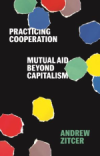
Community Economies Institute announces the 2024 Summer/Winter School.
Researching Postcapitalist Possibilities, 18 to 27 June
A SMALL NUMBER OF PLACES ARE STILL AVAILABLE at some nodes.
Click here for more…
Researching Postcapitalist Possibilities, 18 to 27 June
A SMALL NUMBER OF PLACES ARE STILL AVAILABLE at some nodes.
Click here for more…
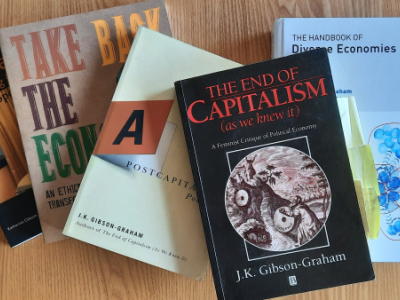
Three new books have been published recently in the Diverse Economies and Livable Worlds book series edited by J. K. Gibson-Graham, Stephen Healy, Maliha Safri and Kevin St. Martin, and published by University of Minnesota Press.
The 9th EMES International Training School will take place in Trento (Italy) from 30 June to July 4, 2024.
The School is held every two years, and the 2024 theme is "Developing Transdisciplinary Research Capacities to Advance the SE Field in the Face of Multidimensional Crises: Exploring the different facets of the…

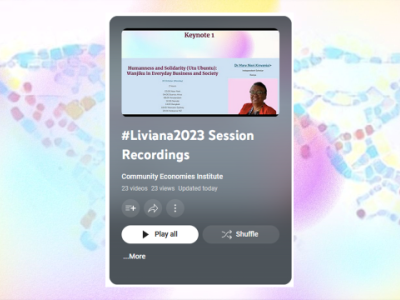
The fourth Community Economies Research Network (CERN) LIVIANA International Online Conference has just concluded and recordings from the 26 sessions have been uploaded to the LIVIANA 2023 Playlist that is part of the…
In Postcapitalist Imaginaries of Finance: A Diverse-Economies Perspective on Equubs within the Ethiopian Diaspora in Germany, a recently published open access article, CERN members Michael Emru Tadesse and…

The concept of the commons has gained traction across multiple disciplines as researchers explore ways we might live ‘in common’ with other people and the world around, and with consideration for the wellbeing of current and future generations. This chapter traces how the work of human geographers builds on research in other fields, including ecology, political science and history. It shows how human geographers attend to
This article is an interview with four researchers about the role of community and community-based initiatives in climate adaptation in urban contexts
This paper explores the multisensory dimension of urban manufacturing to interrogate the spatial possibilities for production in a small town in Switzerland. Together with a group of graduate students, we apply sensory methods to explore how production shapes urban sensescapes and how these sensescapes affect our relation to production.
In this paper, I reflect on multiple “failures” I encountered during my fieldwork on agricultural cooperatives in Kyrgyzstan: from my own “failure” to comply with a linear research design to the alleged “failure” of farmers to cooperate within the formal boundaries of cooperatives. I then suggest how a feminist research practices based on a performative ontology enables a reframing of these experiences that opens space for
This paper questions a widespread narrative that presents cooperative initiatives as mainly unsuccessful in postsocialist contexts. Taking the example of cooperative promotion in Kyrgyzstan after its independence from the Soviet Union, it highlights how this narrative is part of a broader hegemonic discourse on development and on the economy. The paper advances an alternative, postcapitalist, reading of cooperatives and