| Diverse Economies of Care-full healthcare: Banking and Sharing Human Milk Contemporary systems of healthcare and other industries are largely defined by their neoliberal, capitalist character. However, this parochial approach to understanding the political economy of healthcare misses the myriad activities that make up the “care” in healthcare. Receiving care is not isolated to capitalist exchanges, nor is it unquestionably tied to the neoliberal marketplace. There exist diverse economies of care within, outside, and alongside neoliberal capitalist ones. Moreover, there are multiple means by which we may define care that are often overlooked. In many cases healthcare that cannot be counted, does not count, as it relates to capitalist exchange. In this chapter, using the example of the banking and sharing of human milk I demonstrate that other economies of care are happening; and stress that they should be valued in their own right, not solely in relation to capitalism. Milk banking relies on diverse forms of labor—volunteer and paid—while also involving monetary exchange. Milk sharing encompasses barter and trade systems, gift exchange, and the distribution of surplus. Human milk is universally recognized as the best first food for infants. These two forms of accessing human milk make possible the provision of care to infants for parents who are not able to provide milk themselves. Simultaneously, the banking and sharing of human milk raises questions about access and who benefits from these diverse forms of care. Here I argue that the banking and sharing of milk represents economic diversity, yet there are structural limitations related to who can participate in these exchanges. |
| COVID-19, Social Distancing, and an Ethic of Care In 2020, the novel coronavirus (COVID-19) disrupted life around the globe. In the United States, governors issued state of emergency orders and mandated shelter-in-place and social distancing measures. While these measures are important, they ignore the nuances of risk for vulnerable groups, such as older adults. Moreover, social distancing measures made more visible the reality that many patients in care homes often die in isolation. In this commentary, we argue that a rethinking of later-life care is necessary and to understand this need, that critical geographers should expand on how we evaluate care. Here we start from a space of radical care ethics to examine the emotional experience of place and the role it should play in how we think about later-life care. Reflecting on state-mandated social distancing, we show that the current system of geriatric care in the United States does not promote dignified living for older adults and how older adults’ complex emotions are ignored in current later-life care. We conclude by recommending that the emotional experiences of place must be taken into consideration for scholars examining place-based later-life care of older adults. |
| Between paranoia and possibility: Diverse economies and the decolonial imperative Here we reflect on diverse economies scholarship following Gibson-Graham’s call to adopt performative practices for other worlds. Urging scholars to move from paranoia to possibility through weak theory methodology, their call provided momentum for work on economic difference that sustained critiques of capitalocentrism launched in 1996. In this clarion call to read for difference and possibility, a diverse economies framing facilitated a wholesale rejection of strong theory and paranoia. As a subdiscipline in the making, diverse economies scholars are challenged and critiqued as we seek to develop the framework and apply it to economic activities that exist within, alongside, and outside capitalism. Creating the language of diverse economies is continuous; here we consider a geopolitics of knowledge production in reading economic practice for difference, challenging the disuse of strong theory. We argue for deeper engagement with the power imbalances present in building livable worlds, putting diverse economies and decolonial theory in conversation to address power and strike a balance between paranoia and possibility. |
| Solidarity as a development performance and practice in coffee exchanges An(other) world is already existing and present across place. Capitalist-style economic development occurs within and alongside multiple ways of knowing and creating ‘livable worlds.’ Moreover, as part of the multiple ontologies and epistemologies of what it means to live well together, people practice various forms of economic exchanges. In this paper, I examine how the performance of solidarity in the exchange of coffee assists with rethinking development and what it means to build dignified livelihoods and livable worlds. By decentering capitalism and considering multiple forms of economic exchange, such as those built through solidarity networks, I argue that not only is ‘another world possible,’ but that it is present and in the continuous and messy process of becoming. Drawing on over a decade of ethnographically informed work with coffee cooperatives in rebel autonomous zones in Chiapas, Mexico and coffee roasters in the U.S. I ask, how do capitalist and more-than-capitalist exchanges both foster and expose the friction in economic development solidarity work? Here, I address development as multiple, rather than other forms as ‘alternative’ as part of the project of destabilizing capitalist hegemony and making visible already existing performances and practices of development that transcend white, western, and Anglophone ways of knowing and being. |
| The Body as a Site of Care: Food and Lactating Bodies in the U.S. The breast/chestfeeding body is a site of intense politics and power relations in the United States. Hardly a week passes without an incident in the news of a person being publically shamed, or unlawfully asked to change their behavior while using their body to feed their infant in public. Lactating bodies are deemed out-of-place. Simultaneously, birth-parents are judged on their infant feeding practices, with those who do not nurse cast outside of the biologically deterministic ‘good mother’ role. This framing causes the nursing or not-nursing body to become a site of debate. These takes, which point to governance, surveillance, and sexualization of bodies are limiting and have brought these debates to an impasse. What I suggest here is that a re-reading is needed, which situates the body as a site of care, here I focus on the lactating body in particular considering food production, co-production, and consumption. Re-reading the body in this way illuminates how food production and care work are undervalued as related to infant feeding and re-casts the act of nursing as not about ‘women’s bodies’ but about food + care. Ultimately, such work allows for bodies to be considered multiple and as transformational sites of knowledge production. |
| Troubling care in the neonatal intensive care unit The neonatal intensive care unit (NICU) is a site of medical treatment for premature and critically ill infants. It is a space populated by medical teams and their patients, as well as parents and family. Each actor in this space negotiates providing and practicing care. In this paper, we step away from thinking about the NICU as only a space of medical care, instead, taking an anti-essentialist view, re-read care as multiple, while also troubling the community of care that undergirds it. Through an examination of the practice of kangaroo care (skin-to-skin holding), human milk production and feeding, as well as, practices related to contact/touch, we offer a portrait of the performance of the community of care in the space of the NICU. We argue that caring practices taking place in the NICU are multiple and co-produced, while simultaneously being subject to power and knowledge differentials between actors. Here we analyze the negotiations over the knowledge and practice of care(s) to open up the NICU as a particular community of care, and consider care as a both a joint accomplishment and a gatekeeping practice. |
| Fair trade: market-based ethical encounters and the messy entanglements of living well Fair trade certified exchanges are often cast as an ethical purchasing choice compared to those conducted as part of free trade. Producers are cast as members of marginalized communities who can ‘lift themselves out of poverty’ by producing for the certified market. Third-party certifiers claim that consumers can empower producers, reduce poverty, and improve communities through their purchases. Here, fair trade exchanges may be read as a site of ethical encounter. In this chapter I argue that despite attempts to cast fair trade as an ethical encounter, these claims are mired in a capitalocentric worldview that puts profit ahead of people. Drawing on the example of fair trade coffee, which is the most-traded certified product, I re-read fair trade to both illuminate the multiple economic identities and power relations within such exchanges, deconstruct its capitalocentric framing, and offer an avenue for finding hope in the messy entanglements of economic transactions. |
| Fair Trade Rebels: Coffee Production and Struggles for Autonomy in Chiapas Is fair trade really fair? Who is it for, and who gets to decide? Fair Trade Rebels addresses such questions by shifting the focus from the abstract concept of fair trade--and whether it is "working"--to the perspectives of small farmers. It examines the everyday experiences of resistance and agricultural practice among the campesinos/as of Chiapas, Mexico, who struggle for dignified livelihoods in self-declared autonomous communities in the highlands, confronting inequalities locally while participating in a global corporate agricultural chain. Fair Trade Rebels draws on stories from Chiapas that have emerged from the farmers' interaction with both the fair-trade-certified marketplace and state violence. The book addresses the racialized and historical backdrop of coffee production and rebel autonomy in the highlands, underscores the divergence of movements for fairer trade and the so-called alternative certified market, traces the network of such movements from the highlands and into the U.S., and evaluates existing food sovereignty and diverse economic exchanges. Putting decolonial thinking in conversation with diverse economies theory, the author evaluates fair trade not by the measure of its success or failure but through a unique, place-based approach that expands our understanding of the relationship between fair trade, autonomy, and economic development. 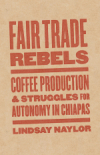
|
| Fair trade coffee exchanges and community economies Despite the shortened commodity chain created for coffee through fair trade, there still exist a number of actors within certified commodity exchange. This chain is populated by disproportionately engaged actors, from a consumer looking for the certification seal, to coffee roasters working directly with coffee producing cooperatives, to producers striving to keep up with the standards for certification. Despite such disparities, connections are made between the roasters and the growers of coffee at multiple sites, from community-based projects to the transfer of knowledge and storytelling beyond the communities where coffee is cultivated. These connections suggest that fair trade exchanges potentially go beyond the sale of a commodity, the creation of surplus value and the connecting of producer and consumer. In this paper I draw on the expanding literature on diverse and community economies to examine fair trade exchanges. The heterogeneous space of the community economy provides a platform for considering the diversity of exchanges happening within, outside and alongside capitalism. In this paper I focus on fair trade certified coffee, moving beyond current explanations of fair trade as ‘alternative’ and working toward a multiplying of our understanding(s) of what fair trade is. |
| Auditing the subjects of fair trade: Coffee, development, and surveillance in highland Chiapas Fair trade certification is a mechanism used by coffee cooperatives to assist farmers with accessing cash income and securing a better price for their product. Third-party certifiers regulate the fair trade label, which is tied not only to price, but also to standards for production and development. In this paper I examine these standards as they are deployed in self-declared autonomous communities in the highlands of Chiapas, Mexico. I argue that third-party certifiers through enforcement of standards, and surveillance attempt to create a producer subject who becomes “fixed” through certification. Drawing from fieldwork with the coffee cooperative Maya Vinic, I provide an example of how farmers negotiate larger political commitments and livelihood strategies while engaging in coffee production. Members of Maya Vinic reside in communities that have declared autonomy from the Mexican state and neoliberal market. These political commitments draw a tension into the landscape as farmers commit land and time to coffee while maintaining subsistence production. Through an examination of the annual fair trade audit, I detail this contradiction as it plays out in the highlands. I conclude that new lines of inquiry must be established that take into account place-based politics as they intersect with fair trade certification. |
| “Some are more fair than others”: fair trade certification, development, and North–South subjects At the same time as fair trade certified products are capturing an increasing market share, a growing number of scholars and practitioners are raising serious questions about who benefits from certification. Through a critique of north–south narratives, this paper draws on contemporary themes in fair trade scholarship to draw out different ways of thinking about fair trade outside of the dichotomous north–south framing. I argue that, through the creation of fair trade subjects of the ‘‘global north’’ and ‘‘global south,’’ certification has normalized and naturalized dichotomous power relations. The primary concern of this paper is to demonstrate the problems with situating certification and scholarship in the north–south binary and to push examination toward a more nuanced analysis of how certification and development are shaped in-place. This intervention is important for assisting with stepping away from long-standing debates regarding the effectiveness of certification, and additionally in contributing to critical thinking on economic development more broadly. |