Publications
The concept of the commons has gained traction across multiple disciplines as researchers explore ways we might live ‘in common’ with other people and the world around, and with consideration for the wellbeing of current and future generations. This chapter traces how the work of human geographers builds on research in other fields, including ecology, political science and history. It shows how human geographers attend to processes of commoning with examples drawn from commons on land, air and sea.
This article is an interview with four researchers about the role of community and community-based initiatives in climate adaptation in urban contexts
This paper explores the multisensory dimension of urban manufacturing to interrogate the spatial possibilities for production in a small town in Switzerland. Together with a group of graduate students, we apply sensory methods to explore how production shapes urban sensescapes and how these sensescapes affect our relation to production. Our study sparks critical questions about mixed-use zoning and tentatively advances the concept of sensible production: a production that not only is perceptible and can actively be engaged with, but that also shows good sense, makes sense, and focuses on what we need.
This paper aims to tentatively explore the benefits of placing art’s knowledge-building tradition, with its capacity to disrupt and reframe, at the centre of how we look at alternative organizing and alternative economic spaces, positioning lived experience, its uncertainties intact, at the heart of researching and practicing social enterprise (SE). The paper explores indeterminacy through two case-study narratives, one of an academic arts-based research project and the other of a unique organization it encountered. It describes the way juxtaposition, encounter and drift value indeterminacy as central to generative processes, challenging the control central tomanagement and its research.
The term “solidarity economy” is most commonly deployed to describe altruistic and socially beneficial ways of doingbusiness, often in opposition to ones that are less so. Drawing on a year and a half of ethnographic fieldwork among Danish minority gangs, this article seeks to open the discussion on solidarity economies beyond these traditional understandings by addingthe perspective of gangs. It explores the more exclusive and violent aspects of solidarity economies, drawing on the analytical lenses of reciprocity and pooling. These dimensions afford the tracing of the conditions of solidarity within that group, rather than the mere verification of its absence orpresence.
This report outlines two approaches to assessing the intentions and outcomes of the non-governmental organisation, Life in Vacant Spaces (LiVS), in Ōtautahi Christchurch. Ōtautahi Christchurch presents a useful case study for wellbeing as it continues to recover from the physical and psychological trauma of earthquakes.
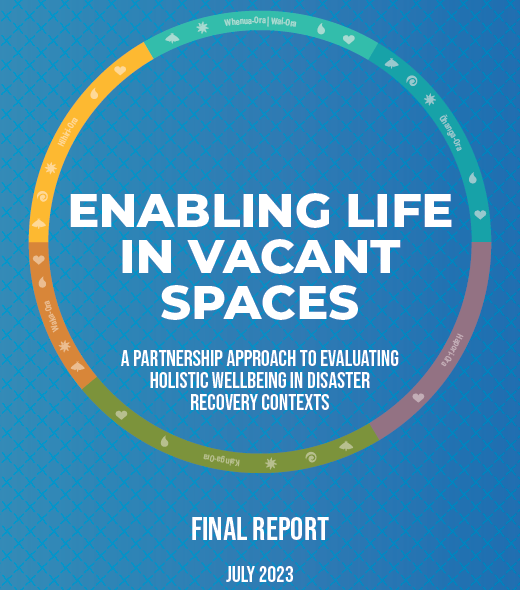
(Open access article)
The article presents an exploratory study of the equub, a form of community-based finance in the Ethiopian diaspora in Germany. Equubs exemplify how People of African Descent in Germany organize against financial exclusion. Grounded in the theory of diverse economies and the method of "reading for difference", the article analyzes the characteristics of the equub as a nonmarket financial institution that contributes to building community economies. Processes of decommodification, collective governance, and ethical decision making around financial needs are discussed alongside the linkages to the diverse economy at large.
This chapter draws on two initiatives situated in Thailand and Cambodia, inspired by strength-based capacity building approaches known as ‘asset-based community development’ (ABCD) and ‘Appreciative inquiry’ (Ai). Our approach challenges western-centric conceptions of equality in participatory design and novelty in creative process. In Cambodia, a failed experiment with bamboo furniture led to the re-evaluation of welfare safety nets and sustainable social arrangements.
This paper questions a widespread narrative that presents cooperative initiatives as mainly unsuccessful in postsocialist contexts. Taking the example of cooperative promotion in Kyrgyzstan after its independence from the Soviet Union, it highlights how this narrative is part of a broader hegemonic discourse on development and on the economy. The paper advances an alternative, postcapitalist, reading of cooperatives and cooperation in Kyrgyzstan and postsocialist contexts more in general.
This paper brings together two streams of literature which rarely enter into conversation: diverse economies scholarship and critical readings of postsocialism. Mobilising the cases of food self-provisioning (FSP) in Czechia and agricultural cooperatives in Kyrgyzstan as an empirical basis for our reflections, we pursue a two-fold aim. Firstly, we call for attention to the postsocialist East as fertile ground for the study of diverse economies. Secondly, we offer a postcapitalist reading of postsocialism as embedded and emancipated theorising, arguing that diverse economies thinking can support novel representations of this geopolitical area and open space to appreciate economic diversity on the ground.
Small-scale food production for domestic use or local markets is common in Finland. In particular, edible gardening and berry- and mushroom-picking are part of everyday life in many households and other small communities; for example, honey is typically produced in small apiaries. In this thesis I examine this phenomenon as an economic activity. Drawing on the theoretical and methodological framework of diverse economies (Gibson-Graham 2006a, 2006b), I understand the economy as an open and non-predefined multiplicity, and I concentrate on situated ways of doing economies in everyday practices of food production. I especially focus on how economies are enacted as more-than-human in small-scale food production and food self-provisioning.
This paper is a response to growing excitement about arts-engaged research in geography. More and more geographers are practicing participatory arts projects to co-investigate pressing issues with communities. However, there are a lack of reflexive discussions about the limits of this work within the confines of the neoliberal and colonial university pressuring researchers to produce 4-star work that makes an impact, or measurable change. Here I add criticality to our understanding of the pitfalls and potential of arts-based analyses. I reflect on interviews with women, queer, non-binary and trans artists who I met during my time as a post-doctoral researcher in Glasgow.
Thanks to Steve Dubb and NPQ for adapting this essay for their readership. This article is, with publisher permission, adapted from a more extensive journal article, “Fight and Build: Solidarity economy as ontological politics,” published this year by Sustainability Science, volume 17, pp. 1207-1221.
Resilience has become a “buzzword” of our time. It is commonplace to hear individuals, communities, organisations, and systems described as resilient. Resilience has also become a buzzword In development discourse and practice. World Bank programmes for instance, refer to ‘resilient cities’, ‘resilient institutions’ and climate risk management ‘resilience strategies’. As noted by developer thinker Andrea Cornwall (2007), buzzwords tend to garner general abstract consensus around the importance of certain concepts but they equally can be vague and ‘fuzzy’, providing little sense of what a concept actually ‘looks like’ or how it translates in practice and in specific contexts. Here, we provide some clarity around the concept of resilience and how it is used in development today.
Trading for a social purpose is nothing new; the Red Cross began trading in order to supplement revenues during the First World War. However, since the 1980s, the not-for-profit sector in many countries has taken a stronger commercial turn. Policy makers in the ‘rich world’ initially became appreciative of social enterprise’s potential for regional development and competitive public services.
The Urban Wellbeing project team developed their ideas in this piece on wellbeing-led governance frameworks and transformative Indigenous tools. In this paper we position our research project in a wider global context.
Read our book review here.
This chapter, written for the Handbook of Alternative Theories of Political Economy, introduces the two primary theoretical traditions that have shaped diverse and community economies research and practice: anti-essentialist Marxian political economy and feminist poststructuralism. The chapter discusses the contribution of these two traditions highlighted how they have shaped the diverse economies and community economies approach. The chapter also includes a discussion of the ever-evolving practice of making community economies and some research directions for a political economy of possibility.
Letter to Julie was written especially for Antònia Casellas's collection, J.K. Gibson-Graham. Hacia una economía postcapitalista o cómo retomar el control de lo cotidiano [J.K. Gibson-Graham. Towards a post-capitalist economy or how to regain control of everyday life], published by Editorial Icaria, Barcelona.
The English translation of the Letter is provided here. In the Letter, written in 2020, Katherine updates Julie on what has happened in the area of diverse and community economies scholarship in the ten years since Julie's death, and on recent events including the climate emergency, COVID-19 and Black Lives Matter.
This book celebrates a decade of Life in Vacant Spaces, affectionately known as LiVS, and the collection of over 700 projects that LiVS have supported in the ten years since the devastating Canterbury earthquakes of 2010/2011. The projects supported by LiVS have varied in shape, scale, location, aims, outputs, participants and people reached.
This book captures just some of the diverse impacts of the projects supported by LiVS, using qualitative research and a series of questions developed by Community Economies researchers to help capture the diversity of impacts. The book is organised around these questions:
¿Es el capitalismo la única realidad existente, una única posibilidad en la que no caben alternativas, tal y como insistentemente se repite? ¿Qué futuro podemos esperar bajo este modelo económico que también busca controlar todo lo que es político, social, y personal? J.K. Gibson-Graham es el pseudónimo conjunto usado por dos geógrafas económicas feministas que, desde principios de los años 1990, vienen mostrando que una visión alternativa al capitalismo es perfectamente posible. Su trabajo se basa en demostrar que el capitalismo no es, ni de lejos, la única vía, que existe una extraordinaria diversidad de praxis económicas y que las personas, a través de nuestras prácticas cotidianas individuales y colectivas, somos agentes de cambio efectivo. J.K.
This essay explores the potential of solidarity economy (SE) as theory, practice, and movement, to engender an ontological politics to create and sustain other worlds that can resolve the existential crises of ecological destruction and historic inequalities. We argue that such a politics is necessary to go beyond the world as it is and exceed the dictates of a dominant modernity—capitalism, white supremacy, patriarchy -- that positions itself as the only singular reality -- or One World World (Law 2011). What is needed are alternatives to development in contrast to alternative developments.
In this piece based on Huong's PhD fieldwork, we think about what a diverse economies and more-than-human approach might offer our thinking on climate change adaptation in Vietnam. While a lot of climate change adaptation interventions have been remodelled modernist development projects reminiscent of the green revolution, we deliberately seek out some of the embodied and local strategies that farmers are using to pay attention and adapt to a changing climate.
Contemporary systems of healthcare and other industries are largely defined by their neoliberal, capitalist character. However, this parochial approach to understanding the political economy of healthcare misses the myriad activities that make up the “care” in healthcare. Receiving care is not isolated to capitalist exchanges, nor is it unquestionably tied to the neoliberal marketplace. There exist diverse economies of care within, outside, and alongside neoliberal capitalist ones. Moreover, there are multiple means by which we may define care that are often overlooked. In many cases healthcare that cannot be counted, does not count, as it relates to capitalist exchange.
An(other) world is already existing and present across place. Capitalist-style economic development occurs within and alongside multiple ways of knowing and creating ‘livable worlds.’ Moreover, as part of the multiple ontologies and epistemologies of what it means to live well together, people practice various forms of economic exchanges. In this paper, I examine how the performance of solidarity in the exchange of coffee assists with rethinking development and what it means to build dignified livelihoods and livable worlds. By decentering capitalism and considering multiple forms of economic exchange, such as those built through solidarity networks, I argue that not only is ‘another world possible,’ but that it is present and in the continuous and messy process of becoming.
In 2020, the novel coronavirus (COVID-19) disrupted life around the globe. In the United States, governors issued state of emergency orders and mandated shelter-in-place and social distancing measures. While these measures are important, they ignore the nuances of risk for vulnerable groups, such as older adults. Moreover, social distancing measures made more visible the reality that many patients in care homes often die in isolation. In this commentary, we argue that a rethinking of later-life care is necessary and to understand this need, that critical geographers should expand on how we evaluate care. Here we start from a space of radical care ethics to examine the emotional experience of place and the role it should play in how we think about later-life care.
Here we reflect on diverse economies scholarship following Gibson-Graham’s call to adopt performative practices for other worlds. Urging scholars to move from paranoia to possibility through weak theory methodology, their call provided momentum for work on economic difference that sustained critiques of capitalocentrism launched in 1996. In this clarion call to read for difference and possibility, a diverse economies framing facilitated a wholesale rejection of strong theory and paranoia. As a subdiscipline in the making, diverse economies scholars are challenged and critiqued as we seek to develop the framework and apply it to economic activities that exist within, alongside, and outside capitalism.
This chapter is about asset-based community development (ABCD) in Mindanao. Specifically, it is about a locally adapted ABCD approach that has emerged from development practitioners adapting and translating ABCD concepts and methods to make them more culturally relevant. The chapter examines how the use of language and communication tools, in conjunction with an emphasis on local empowerment, contribute to enabling a more culturally relevant form of ABCD. The chapter opens up a space of conversation between linguists, development scholars, ABCD practitioners, and a larger research community. It invites wider application of learnings from Mindanao, and furthers thinking on the application of linguistics in development theory and practice.
This paper is a set of reflections from researchers in the Center for Sustainable Communities, University of Canberra, drawing out emerging lessons from the process of re-configuring research methods during COVID-19. The pandemic has presented new spaces of negotiation, struggle, and interdependence within research projects and research teams. It has left researchers often uncertain about how to do their work effectively. At the same time, it has opened up opportunities to re-think how researchers undertake the work of research. In this paper we reflect on several current research programs that have had to undergo rapid design shifts to adjust to new conditions under COVID-19.
This article considers organizational solidarity in practice—modes of organizing rooted in solidarity, relationality, coalition-building, and difference. It does so by studying two Latin American illustrative cases: Bolivia’s campesino-indígena movements coalescing traditional practices and urban-neighborhood experiences in order to self-organize socio-political spaces; and Argentina’s worker-led empresas recuperadas por sus trabajadores (worker-recuperated enterprises), where workers have been drawing on working-class self-activity to convert companies to cooperatives and self-manage spaces of production.