| 7. Community This article is an interview with four researchers about the role of community and community-based initiatives in climate adaptation in urban contexts |
| Cooling the Commons pattern deck The Cooling the Commons pattern deck is a website comprising 41 illustrated patterns of ‘cool commons’. Cool commons are publicly accessible cool urban environments that offer an alternative to airconditioned private spaces in cities where heat is compromising liveability. The website is designed as an open resource to facilitate design decisions that defend, protect, and enhance the presence of cool commons. The pattern deck builds upon the research report Cooling Common Spaces in Densifying Urban Environments which explored cool commons of relevance to Landcom’s urban renewal sites and included 5 prototype patterns. The Cooling the Commons pattern deck expands upon that study to offer 5 revised and 36 new patterns for cool commons. As a work of commons-based design it offers an alternative to and makes an intervention into the technical approach to design that dominates urban heat adaptation via for example air-conditioning, green infrastructure and ‘cool roads’. Funded by both UTS and Western Sydney University, the deck demonstrates the importance of collegial, collaboratively partnered research. 
|
| Cultivating the Habits of Coolth This chapter extends upon the book's discussions of habit to the process of adapting to anthropogenically induced global warming. We reveal the role of designed practices, products and infrastructures in habituating urban populations to a changing climate. Our central concern is the ‘world within the world’ design has helped to create. In the rapidly densifying city, atmospheric commons are shaped and reshaped by human design; climate change is lived and felt in hostile heat islands and polluted, particulate-laden city air. Design offers a critical perspective on the dynamics that have shaped the city and organised the civic practices of its inhabitants. This ontological capacity is a second order agency rarely considered in the contexts in which design is most powerfully deployed to shape the materiality of the city. We apply ‘defuturing’ (Fry, 1999) as a critical deconstructive mode of reading to point to the designing relations shaping city atmospheres, infrastructures and modes of habituation. Our focus is the constellation of designing relations inaugurated by cooling technologies. At the same time as answering a primal need, cooling technologies also dehabituate us to the increasingly volatile conditions of our common world. In response, we seek to resuscitate the concept of ‘coolth’ as a critical term describing the experience and sensation of feeling (temperature) cool. We claim that designing for coolth cultivates habits of practice far better attuned to a warming world, recognising that climate-aware modes of dwelling must be both cultivated and habituated by design. 
|
| A Conversation about the Weather Increasingly, other-than-scientific questions and creative expressions of climate change are gaining ground as legitimate forms of new knowledge in the fields of feminism, environmental humanities, environmental cultural studies and design studies, of which this piece of work is a part. The work offers a novel contribution to this interdisciplinary scholarship by creatively interpreting the perspectives, experiences and practices of people living with urban heat in Penrith NSW as an imagined conversation between a mother and child. The conversation, which was originally performed as part of the Hacking the Anthropocene II: Weathering Symposium held at University of Sydney in May 2017, connects spoken experiences, memories and aspirations drawn from the Cooling the Commons pilot study with images of the designed environments that shape, powerfully but often tacitly, people's everyday social practices. 
|
| Cooling Common Spaces in Densifying Urban Environments: A Review of Best Practice and Guide for Western Sydney Renewal In answering the following research question: What design features allow for both comfort and mobility in the hot city, and what design features detract from this? What climate-resilient social practices are these features enabling and disabling? this report develops a new approach to understanding and designing cool cities: cool commons. The report sets out the new conceptual approach of Cool Commons. It moves beyond current technocentric approaches to cool urban futures, recognising that a combination of material, social and institutional strategies are required to support climate adaptation, including community-led adaptive practices. ‘Cool commons’ view the city not as a collection of private spaces, but as an environment for convivial social life. The design challenge is thus to integrate opportunities for respite or coolth across the city, for example, in public spaces that are accessible to all. The report also sets out a methodology for analysing and reporting on the extent of Cool Commons, drawing on the pattern language of architect and mathematician Chris Alexander. It provides a series of sample patterns for Cool Commons that are the foundation for the ‘Cool Commons Pattern Deck’. 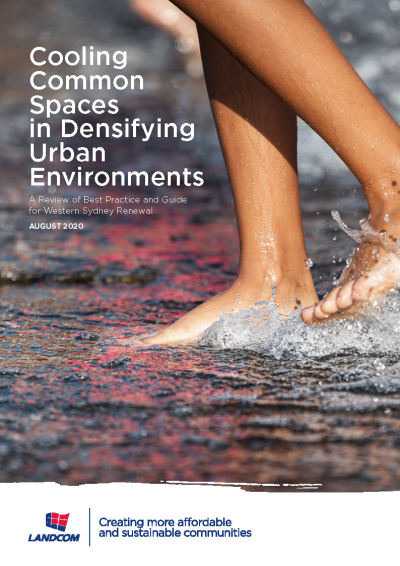 |
| Cooling the Commons Pilot Research Study This pilot study provides initial insights into how residents living in Western Sydney keep cool during the hottest parts of the year and how they would like to see their living environments, at home and out and about, modified to improve wellbeing in a climate changing world. The research responds to the lack of qualitative information about: day to day living practices in outer suburban Sydney; the constraints people experience when trying to keep cool; and, people’s aspirations for more comfortable living environments. The pilot study introduces the concept of the ‘cool commons’ to identify those spaces that offer cooler temperatures than surrounding areas and that are used by, and are accessible to, a community of commoners who to some degree, care for, take responsibility for, and benefit from this coolness. 
|